
Australia’s National Disability Insurance Scheme (NDIS) supports hundreds of thousands of Australians with disability, and NDIS providers across the country need experienced workers to deliver that support. Many providers cannot find enough local staff, especially in regional areas, so they are turning to employer sponsorship. If you already work in disability support in Australia, your experience may qualify you for 482 visa sponsorship as a Community Worker, Residential Care Officer or Youth Worker, even if your job title is “Disability Support Worker”.
This guide explains how NDIS services connect to these occupations, why your duties matter more than your job title, what you need to be sponsored, and how to send us your details if you are looking for an NDIS job with visa sponsorship.
NDIS services and the workers providers need
NDIS providers are registered to deliver different types of support, known as registration groups. A single provider may deliver several of them, for example:
- Assistance with daily life and daily personal activities: helping participants with personal care, meals and household tasks;
- Assistance in shared living arrangements, including Supported Independent Living (SIL) in group homes;
- Participation in community, social and civic activities and capacity building: helping participants build skills, join activities and become more independent;
- Allied health and nursing services; and
- Transport and community access.
NDIS participants receive funding for the supports in their plans. Much of that funding is for community participation, capacity building and supported living, which is why providers are actively looking for experienced community workers and residential care officers, not only general support workers.
Your duties decide your occupation, not your job title
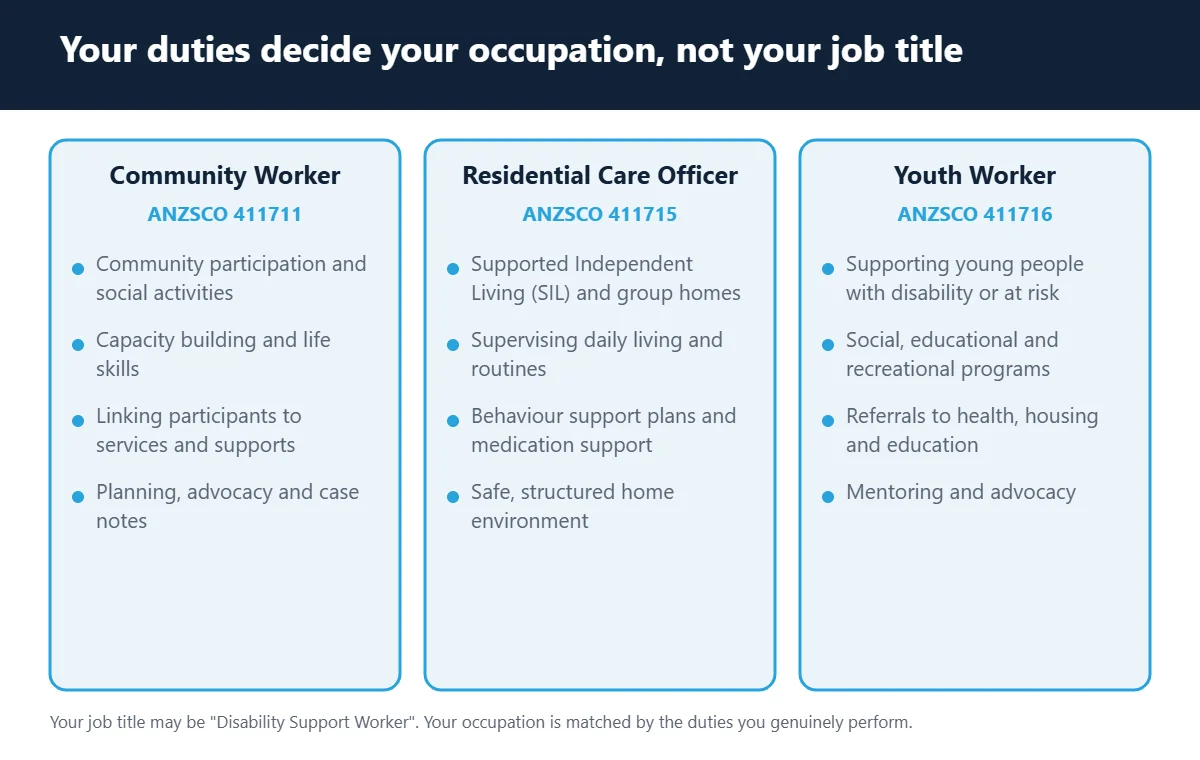
Many workers in the NDIS sector have the job title Disability Support Worker or Support Worker. For visa purposes, the Department of Home Affairs looks at the duties you actually perform, not just your title. The occupation you can be nominated in depends on what you really do day to day:
- Community Worker (ANZSCO 411711): you support participants to take part in the community, build life skills and independence, connect them with services, plan activities and goals, advocate for them and keep case notes.
- Residential Care Officer (ANZSCO 411715): you work in a group home or SIL setting, supervising and supporting residents with daily living, routines, behaviour support plans and medication support, and maintaining a safe home environment.
- Youth Worker (ANZSCO 411716): you support young people with disability or young people at risk through social, educational and recreational programs, mentoring, advocacy and referrals.
These occupations are on the Core Skills Occupation List, which means they can be nominated for the Skills in Demand visa (subclass 482), Core Skills stream.
Important: your duties must be genuine and supported by evidence, such as your employment contract, position description, payslips and a statement of service from your employer. Describing your role inaccurately to fit an occupation can lead to a visa refusal, so the occupation must truly match the work you do.
What you need for 482 sponsorship
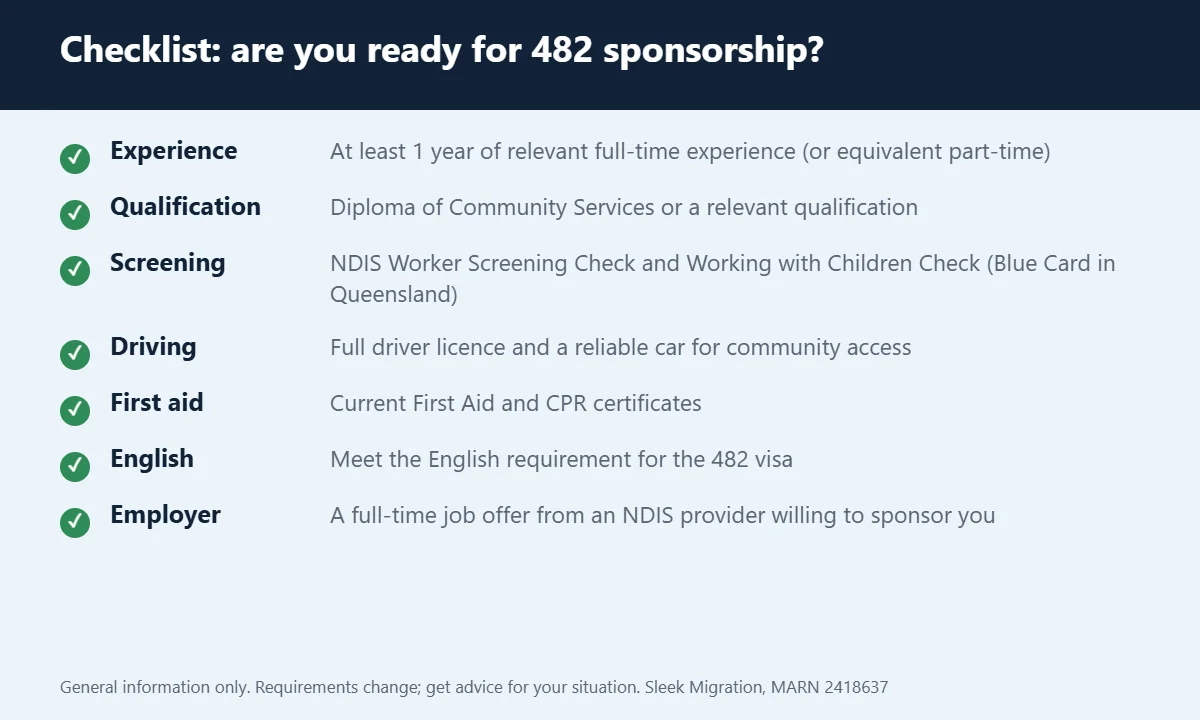
Every case is different, but NDIS employers and the visa requirements generally look for:
- Experience: at least one year of relevant full-time work experience (or the part-time equivalent) in the occupation;
- Qualification: a Diploma of Community Services or another relevant qualification. A skills assessment may also be required in some cases;
- Screening checks: a current NDIS Worker Screening Check and Working with Children Check (called a Blue Card in Queensland);
- Driving: a full driver licence and a reliable car, because community participation work usually involves taking participants to activities and appointments;
- First Aid and CPR certificates;
- English: you must meet the English language requirement for the 482 visa; and
- A job offer: a full-time position with an approved sponsor that pays at least the market salary and the Core Skills Income Threshold.
Pay rates: what community and disability workers can earn
Community workers and residential care officers in the disability sector are usually paid under the Social, Community, Home Care and Disability Services Industry Award (SCHADS Award). Your pay depends on your classification level, experience and the hours you work.
For example, the SCHADS Level 3 (pay point 1) rate from 1 July 2026 is around $40.49 per hour, which is about $80,000 a year for a full-time 38-hour week before penalty rates. On top of the base rate, the award pays extra for work outside normal hours:
- evening and night shift loadings;
- Saturday work at 150% and Sunday work at 200% (full-time and part-time employees); and
- public holiday work at 250%.
Depending on your classification, roster, and how many evening, weekend and public holiday shifts you work, total annual earnings for full-time community and residential care workers may be around $80,000 to $120,000. This is a general guide only. Your actual pay depends on your employment contract, the award and the hours you work.
NDIS jobs with visa sponsorship across Australia
Sleek Migration works with NDIS and disability service providers in every state and territory, including in:
- Northern Territory: Alice Springs and Katherine;
- Western Australia: Rockingham and Perth;
- Victoria: Moe, Swan Hill and Mildura;
- South Australia: Adelaide and Prospect; and
- Queensland: Cairns, Townsville, the Gold Coast and the Sunshine Coast.
Many of these locations are in regional Australia, where demand for experienced disability workers is especially strong.
How to apply: send us your details
If you perform the duties of a community worker, residential care officer or youth worker, regardless of your job title, and you are looking for a disability support job with visa sponsorship, email us at info@sleekmigration.com with:
- your resume and current visa type and expiry date;
- your qualifications (for example, Diploma of Community Services);
- copies of your NDIS Worker Screening Check, Working with Children Check or Blue Card, driver licence, and First Aid and CPR certificates; and
- a short description of your duties and the NDIS services you work in (community participation, SIL, capacity building and so on).
Where your profile suits their needs, we may recommend you to NDIS employers who are looking for experienced community workers, residential care officers and youth workers. Interviews, job offers and sponsorship decisions are made by the employers, not by Sleek Migration, and any visa depends on you meeting the requirements.
From 482 visa to permanent residency
The 482 visa (Core Skills stream) allows you to live and work in Australia for your sponsoring employer for up to four years. After working for your sponsor for the required period, generally two years, you may be eligible for permanent residency through the Employer Nomination Scheme visa (subclass 186), Temporary Residence Transition stream, if you meet the age, English, skills and other requirements at that time.
Information for NDIS providers
If you are an NDIS provider struggling to fill community worker, residential care officer or youth worker positions, employer sponsorship can help you retain experienced staff who already know your participants and services. Sleek Migration helps NDIS providers with Standard Business Sponsorship, nominations, position descriptions, employment contracts aligned with the SCHADS Award, labour market testing and sponsorship compliance.
Frequently asked questions
Can a disability support worker be sponsored for a 482 visa?
Possibly. “Disability Support Worker” is a job title. If the duties you genuinely perform match an occupation on the Core Skills Occupation List, such as Community Worker (411711), Residential Care Officer (411715) or Youth Worker (411716), an NDIS employer may be able to sponsor you in that occupation.
What is the difference between a community worker and a residential care officer?
A community worker mainly supports participants in the community, with social participation, capacity building and access to services. A residential care officer mainly works in a group home or Supported Independent Living setting, supervising and supporting residents with daily living.
Do I need a Diploma of Community Services?
A Diploma of Community Services or another relevant qualification is strongly preferred by employers and helps show you have the skills for the occupation. Requirements depend on your case, so get advice before applying.
Do I need a car?
For most community worker roles, yes. You will usually need a full driver licence and a reliable car to take participants to activities and appointments.
How much do community workers earn in Australia?
Under the SCHADS Award, a full-time Level 3 worker earns about $80,000 a year before penalty rates. With evening, weekend and public holiday shifts, total earnings may be around $80,000 to $120,000, depending on the classification, roster and hours.
Related guides
- NDIS provider sponsorship: how to sponsor disability workers
- Disability support worker visa sponsorship in Cairns and Townsville (FNQ and Townsville DAMA)
Get advice from a Registered Migration Agent
Every situation is different, and visa requirements change. Sleek Migration is led by Dr Majid Panahandeh Fard, Registered Migration Agent (MARN 2418637). We work with NDIS providers and disability workers across Australia on employer sponsorship, 482 and 186 visas, and skills assessments.
Contact us: 2703/31 A’Beckett Street, Melbourne VIC 3000 | info@sleekmigration.com | Book a consultation
This article is general information only and is not legal or migration advice. Visa requirements, pay rates and income thresholds change regularly. Pay information is a general guide based on the SCHADS Award and is not a promise of earnings. Information checked November 2026.