
Australia’s meat processing industry depends on skilled workers. Abattoirs and meat processing plants across Victoria, New South Wales, Queensland, South Australia and Western Australia process beef, lamb, mutton, goat and kangaroo for Australian supermarkets and export markets, and many of them cannot find enough local workers for the kill floor and the boning room. To fill this gap, the Australian Government created the Meat Industry Labour Agreement (MILA), which allows approved meat processors to sponsor overseas and temporary-visa workers as Skilled Meat Workers.
If you are already in Australia on a Working Holiday visa, including Vietnamese workers on the Work and Holiday visa (subclass 462), and you are working as a boner, slicer or slaughterer, this guide explains how the MILA works, how to find meat worker jobs with visa sponsorship, and how your job can become your pathway to employer sponsorship and permanent residency.
What is the Meat Industry Labour Agreement (MILA)?
A labour agreement is a formal agreement between an Australian employer and the Department of Home Affairs that allows the employer to sponsor overseas workers when it cannot find enough Australians to fill skilled roles. The Meat Industry Labour Agreement is an industry labour agreement. Its terms are set by the Government for the whole meat processing industry and are not negotiable, so every approved meat processor works under the same rules.
Under the MILA, an approved employer can sponsor workers for:
- the Skills in Demand visa (subclass 482), Labour Agreement stream, for up to four years;
- the Skilled Employer Sponsored Regional visa (subclass 494) in eligible regional areas; and
- the Employer Nomination Scheme visa (subclass 186), which is permanent residency, after the worker has worked for the sponsoring employer for three years.
Which jobs are covered? Skilled Meat Worker roles
The MILA covers one occupation: Skilled Meat Worker. There is no separate ANZSCO code for this occupation, so code 070499 is used when nominating it. The role covers the skilled duties of an ANZSCO Slaughterer and Meat Boner and Slicer, including:
- Boner: separating meat from the bone on beef, lamb, mutton, goat or kangaroo carcases in the boning room;
- Slicer: cutting and trimming meat into primal and retail cuts to customer and export specifications;
- Slaughterer and kill floor operator: stunning, sticking, dressing and processing livestock on the kill floor (slaughter floor) in line with animal welfare and food safety standards.
In job advertisements these roles are often called skilled boner/slicers, knife hands, slaughterpersons or kill floor operators. Labourers, packers and general process workers are generally not covered. The work must be skilled meat processing work in an approved meat processing establishment.
MILA requirements for Skilled Meat Workers
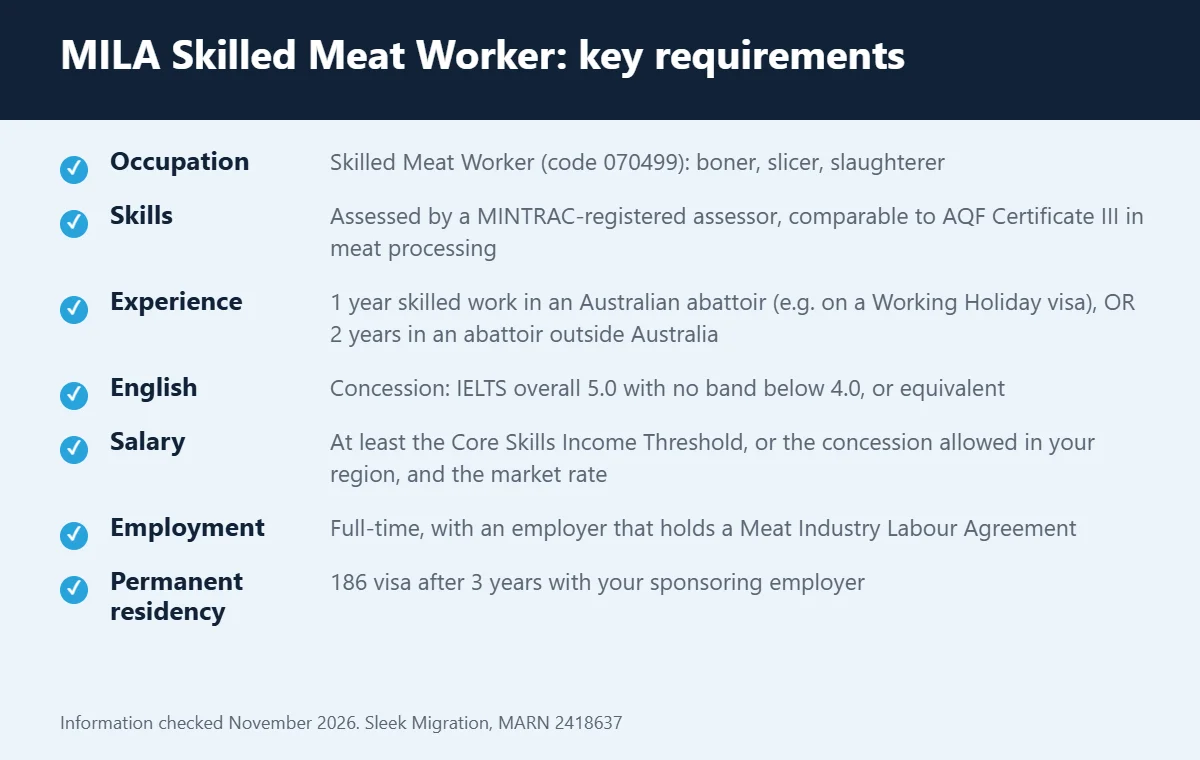
1. Skills assessment
You must be assessed as a skilled meat worker at a level comparable to an AQF Certificate III in Meat Processing. The assessment is done by a MINTRAC-registered assessor or another assessor approved by the Commonwealth. In practice, the assessor checks your knife skills, speed and quality on the job, so real experience on the kill floor or in the boning room is essential.
2. Work experience
The experience you need depends on where you gained it:
- Working in Australia: one year of skilled work in an Australian abattoir or meat processing establishment, for example while holding a Working Holiday or Work and Holiday visa, makes you eligible; or
- Working outside Australia: two years of skilled work in an abattoir or meat processing establishment overseas.
The one-year option is very important for Working Holiday makers. Your time working as a boner, slicer or slaughterer in an Australian abattoir counts towards the experience you need for sponsorship.
3. English language
The Meat Industry Labour Agreement includes an English language concession. Instead of the standard requirement, you need an overall IELTS score of 5.0, with no band (listening, reading, writing or speaking) below 4.0, or an equivalent score in another accepted test such as PTE Academic. This makes the visa much more accessible for skilled meat workers whose first language is not English.
4. Salary and full-time work
You must be employed full-time. Your salary must be at least the market rate paid to Australian workers doing the same job and at least the Core Skills Income Threshold (CSIT), unless a regional concession in the agreement applies. In some regional locations the agreement allows a salary concession, but you can never be paid less than an Australian worker in the same role.
5. Age
There is no age limit for the 482 visa under the MILA. For the 186 and 494 visas, standard age rules apply in Category 1 locations, and applicants in Category 2 and 3 regional locations must be under 55 at the time of application.
From Working Holiday visa to sponsorship: a guide for Vietnamese meat workers
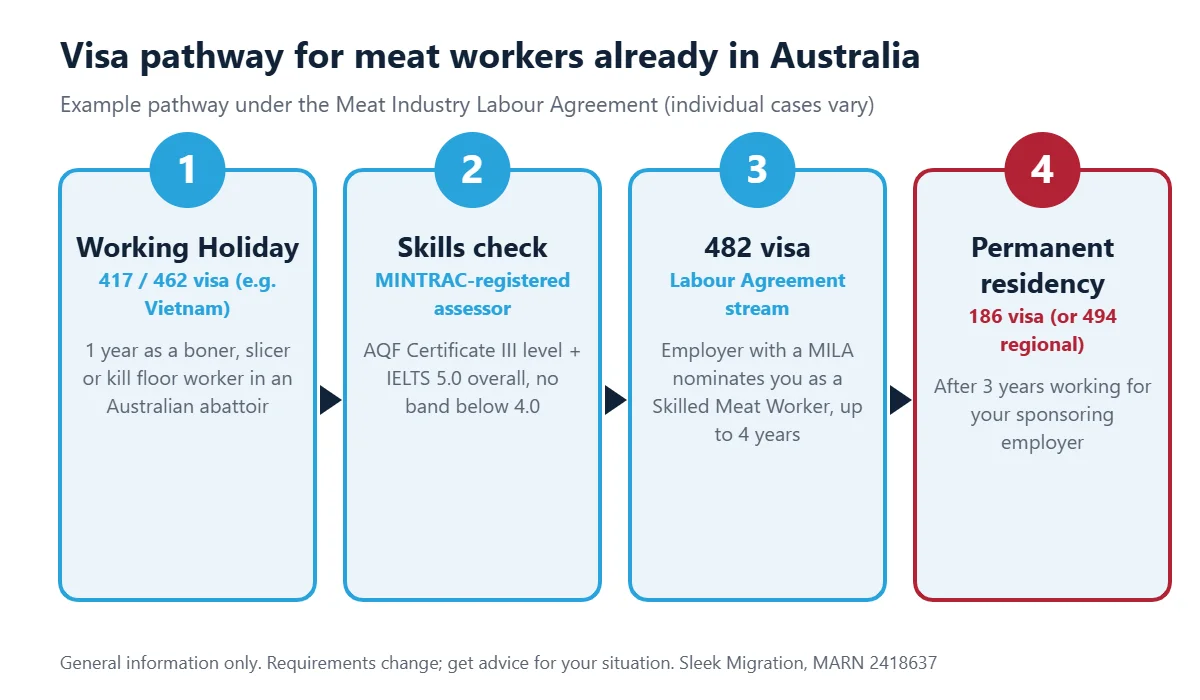
Many Vietnamese workers come to Australia on the Work and Holiday visa (subclass 462) and find jobs in abattoirs and meat processing plants in regional Australia. If this is you, your current job may be the first step towards a long-term future in Australia:
- Gain experience on the job. Work in the boning room or on the kill floor and build your skills as a boner, slicer or slaughterer. Keep your payslips, employment contract and any training records, because you will need them as evidence.
- Talk to your employer. Ask whether your employer has a Meat Industry Labour Agreement, or is willing to apply for one, and whether they will sponsor you.
- Prepare your English. Start preparing early for IELTS or PTE so you can meet the English requirement.
- Complete the skills assessment with a MINTRAC-registered assessor.
- Apply for the 482 visa after your employer’s nomination is lodged.
- Plan for permanent residency. After working for your sponsoring employer for three years, you may be eligible for the 186 permanent visa.
Important for Working Holiday makers: your visa has work conditions, including limits on how long you can work for one employer. Check your visa conditions in VEVO, and get advice before your visa expires. Timing matters, because you usually need to lodge your next visa while you still hold a valid visa in Australia.
Meat worker jobs with visa sponsorship: Rockhampton, Swan Hill, Colac, Adelaide and Perth
Sleek Migration works with meat processing employers across Australia, including in Rockhampton (Queensland), Swan Hill and Colac (Victoria), Adelaide (South Australia) and Perth (Western Australia). These employers process beef, lamb and game meat and are looking for experienced boners, slicers and kill floor workers.
How to apply: send us your video portfolio
If you are already working as a boner or slicer, or on the kill floor, and you are looking for a meat worker job with visa sponsorship, email us at info@sleekmigration.com with:
- your resume, current visa type and expiry date;
- details of your meat processing experience (where you worked, how long, and whether it was beef, lamb or kangaroo); and
- a video portfolio of about five minutes showing you at work, for example boning, slicing or working on the kill floor.
We will share your profile and video with our meat processing employers. If an employer is interested, they may contact you for an interview. Please note that job offers are made by the employers, not by Sleek Migration, and sponsorship depends on the employer’s needs and on you meeting the visa requirements.
Beef, lamb and kangaroo processing: where the jobs are
Meat processing jobs are found in every state, mostly in regional areas close to cattle and sheep farming. Beef processing is concentrated in Queensland, New South Wales and Victoria. Lamb and mutton processing is strong in Victoria, South Australia, New South Wales and Western Australia. Kangaroo and other game meat is processed by specialist game meat processors. Many of these locations are in designated regional areas, which can give access to the 494 regional visa and regional concessions.
Information for employers: sponsoring skilled meat workers
If you operate an abattoir or meat processing establishment and cannot find enough skilled boners, slicers and slaughterers, the MILA lets you sponsor workers who are already trained, including temporary visa holders who already work for you. To use the agreement, your business must:
- be an Australian meat processing establishment that meets the agreement’s criteria;
- show genuine efforts to recruit Australian workers through labour market testing;
- pay sponsored workers at least the same as Australian workers in the same role; and
- meet your sponsorship obligations, including record-keeping and notifying the Department of changes.
Sleek Migration helps meat processors with the full process: the labour agreement request, nominations, visa applications, employment contracts and compliance.
Frequently asked questions
Can a Working Holiday visa holder be sponsored under the Meat Industry Labour Agreement?
Yes, if you meet the requirements. One year of skilled work in an Australian abattoir or meat processing establishment, for example on a Working Holiday or Work and Holiday visa, meets the experience requirement. You also need a skills assessment, English (IELTS 5.0 overall with no band below 4.0) and a full-time job offer from an employer with a MILA.
How much experience do I need if I worked in an abattoir overseas?
If your experience is from outside Australia, you need two years of skilled work as a boner, slicer or slaughterer in an abattoir or meat processing establishment.
What IELTS score do I need for a meat worker visa?
Under the English concession in the Meat Industry Labour Agreement, you need an overall IELTS score of 5.0 with no band below 4.0, or an equivalent score in another accepted English test.
Can I get permanent residency as a meat worker in Australia?
Yes. The MILA includes a pathway to the subclass 186 permanent visa. You need to work for your sponsoring employer for three years and meet the other requirements, including age, English and the skills assessment.
Does my employer need a labour agreement?
Yes. Skilled Meat Worker is not on the standard occupation lists, so your employer must have a Meat Industry Labour Agreement (or apply for one) before it can nominate you.
Tóm tắt bằng tiếng Việt: Visa bảo lãnh ngành chế biến thịt tại Úc
Nếu bạn đang ở Úc với visa Work and Holiday (subclass 462) và làm việc trong lò mổ hoặc nhà máy chế biến thịt (khu giết mổ hoặc phòng lọc xương), bạn có thể được chủ lao động bảo lãnh theo Thỏa thuận Lao động Ngành Thịt (Meat Industry Labour Agreement – MILA). Yêu cầu chính gồm: đánh giá tay nghề Skilled Meat Worker (boner, slicer, slaughterer); một năm kinh nghiệm tại lò mổ hoặc nhà máy chế biến thịt ở Úc, hoặc hai năm kinh nghiệm ở nước ngoài; IELTS tổng 5.0, không kỹ năng nào dưới 4.0 (hoặc tương đương); và hợp đồng làm việc toàn thời gian. Sau ba năm làm việc cho chủ bảo lãnh, bạn có thể nộp đơn xin thường trú (visa 186). Chúng tôi đang hợp tác với các nhà máy chế biến thịt tại Rockhampton, Swan Hill, Colac, Adelaide và Perth. Hãy gửi email đến info@sleekmigration.com kèm sơ yếu lý lịch và video khoảng 5 phút quay cảnh bạn đang làm việc (lọc xương, cắt thịt hoặc làm ở khu giết mổ).
Related guides
- Meat boner, slicer and slaughterer visa: abattoir jobs with visa sponsorship
- How abattoirs and meat processors can sponsor meat workers
Get advice from a Registered Migration Agent
Every case is different, and labour agreement requirements change. Sleek Migration is led by Dr Majid Panahandeh Fard, Registered Migration Agent (MARN 2418637). We work with meat processors and meat workers across Australia on Meat Industry Labour Agreement sponsorship, 482 and 186 visas, and skills assessments.
Contact us: 2703/31 A’Beckett Street, Melbourne VIC 3000 | info@sleekmigration.com | Book a consultation
This article is general information only and is not legal or migration advice. Visa requirements, income thresholds and labour agreement terms change regularly. Information checked November 2026.